There has been a recent spate of racist and xenophobic online comments in response to a devastating flash flood disaster in Nepal as well as the news about SIA’s (Singapore Airlines) continued investments in the struggling Air India (see Matthews et al., 2026; Mohan, 2026). The decrying of these racist and xenophobic online comments by public figures and laypeople in social media and mainstream media has been strong and is a welcomed indication of the recognition of the ugliness of racism and xenophobia. The authorities’ swift action in investigating the racist and xenophobic online comments is expected and sends a clear signal that such behaviours are not tolerated. These reactions reflect a strong belief among the governing and the governed that racism and xenophobia have no place in Singapore’s multiracialism and are positive indications of the seriousness of the matter and the need to maintain racial harmony, considering the speed and resolute characteristic of many of these responses, especially from the political leaders.
The reactions from the public, largely via social media, offers an organic negative informal sanctioning which is crucial in explicitly reinforcing and/or shaping the types of social norms that are desired. While the authorities’ formal sanctions may provide a legal and punitive response that explicitly carries the Singaporean brand of multiracialism as the normative stance, it is a prescriptive state-endorsed response that may not adequately reflect public sentiments. Which is why informal sanctions arguably set a stronger tone concerning the norms that are socially desired as well as provide a sense of the public’s perspectives on racism, xenophobia, harmony, multiculturalism, and multiracialism. This does not mean that formal sanctions are not useful or needed, but that we have to understand that state narratives and approaches, while necessarily having an impact on individuals’ views and behaviours, are essentially also in interaction with individuals’ views and behaviours. Individuals respond to and interpret state narratives and responses. Likewise, the state and government may at times do the same by listening to and observing the groundswell. Social media, which was where the problem initially arose, functions as an efficient platform where public responses can drown out the offending comments.
The groundswell reflected on the social media, from my anecdotal observations (what I read and viewed) thus far, generally projects an abhorrence of the racist and xenophobic online comments. The general disgust towards certain bad actors (in this case, the online commenters, provided they are not bots) and their bad actions is understandable and for valid reasons. Interestingly, and perhaps expectedly, there are also denouncements of these bad actors as failing to embody what it means to be a Singaporean. That to be identified as a Singaporean, one must adhere and embrace multiracialism. But how are the ideas of Singaporean and multiracialism understood? This is a curious question as the racist and xenophobic online comments, specifically regarding the families of the missing Singaporeans in the Nepal disaster, were made on an assumption that the targets of the commenters’ ire are not Singaporeans (or, specifically, Singaporean Indians because they were alleged to not look or sound like Singaporeans)1.
Formal punitive responses targeting these bad actors, when conducted, will reinforce the “individual bad actors” approach and view. However, the underlying issue could perhaps be far deeply rooted. Although holding these bad actors responsible is in itself important, the social diagnosis of the problem cannot stop at naming and/or punishing racist and xenophobic individuals and behaviours. This is a corrective measure akin to a prescribed medicine to resolve an observable racist and xenophobic instance. Much less discussed and examined, especially in the public discourse (which includes layperson responses on social media), is how this problem relates to and emerges from our hyper race-conscious context. While individuals with malicious racist and xenophobic intents do exist, many of those who behave badly are often not simply individuals who willed themselves into villainous racists and xenophobes. Chances are they are products of a racist milieu or at least a racialised milieu2.
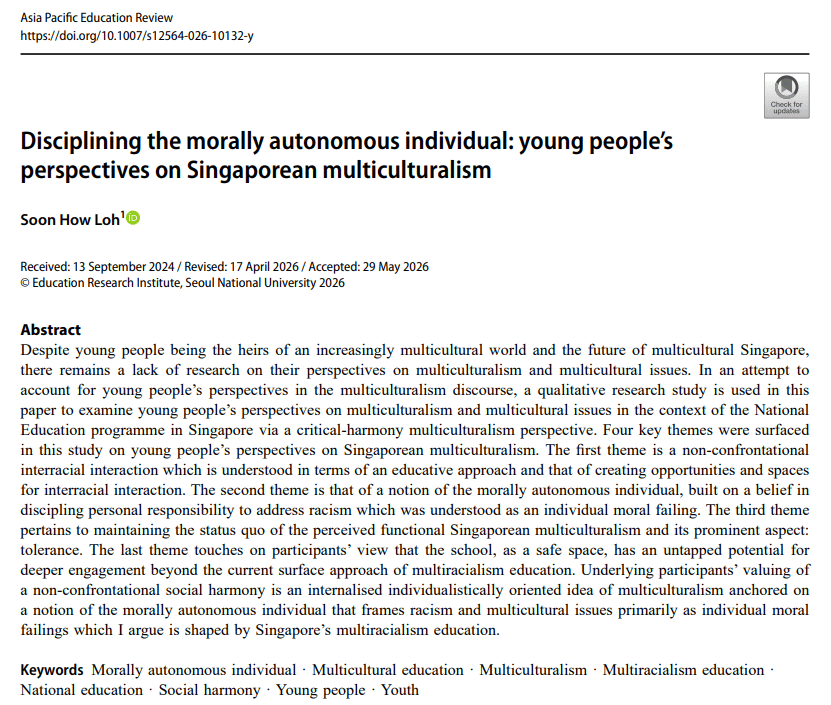
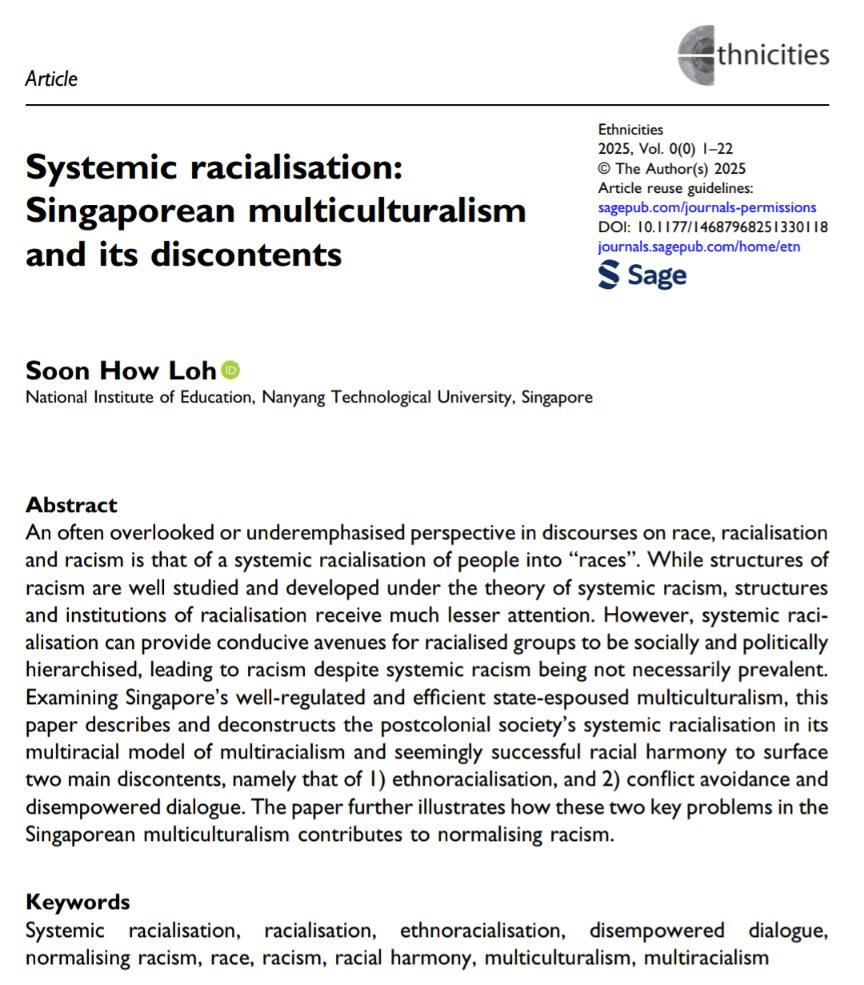
Multiracialism is typically assumed as a public good and a valuable principle in the social organisation of the Singaporean society. But it is fundamentally, at the very least, a racialised milieu which requires as its normative basis a biological/social “reality” of heightened race consciousness. The thing with criticisms of multiracialism is that it can end up over-emphasising racist intentions of multiracialism and its supporters. This is often based on it being modelled after British colonial racialised policies on social organisation which are racist in their origins and conceptions. However, there is a need to account for the historical and political developments and institutionalisation of multiracialism and how it was and is employed in the organisation of Singaporean everyday life. Furthermore, it it is important to note that, despite its flaws, Singaporean multiracialism is invested in the politics of recognition3. And for good reasons. This is why it is a challenging and difficult topic to discuss, and many proponents of Singaporean multiracialism would understandably prefer to maintain the status quo and not tinker with a system that to them is, overall, functioning well. But my view is that the flaws of Singapore’s multiracialism should not be ignored. We need to re-examine Singaporean multiracialism and its problem of reproducing race as well as the systemic racialisation that it entails. It has to be juxtaposed with a suitable form of multiculturalism. Along this vein, we have to work out what is actually means to be a multiracial society and the implications of our definition of it. Considering the systemic racialisation of the Singaporean society and the relatively rigid model of our understanding and interpretation of multiracialism and what is a multiracial Singapore, a narrowly framed multiracialised national identity is arguably taking root (Loh, 2025). The recent racist and xenophobic online comments may be an indication, out of a series of similar past incidents, of such a multiracialised national identity, and it could be a call for concern. While we continue to sanction individual bad actors4, we have to also look into the racialised milieu that provides the conducive context for racism and xenophobia to take root, likely masked under a notion of a multiracialised perspective, contributing to a multiracialised habitus.
References
ChannelNewsAsia. (2026, September 09). 5 people identified and interviewed over comments on Nepal floods, SIA’s Air India investment: Police. ChannelNewsAsia. https://www.channelnewsasia.com/singapore/5-people-nepal-floods-sia-air-india-online-comments-6371351
Loh, S. H. (2025). A multiracialised national identity: Singaporean multiracialism and national identity. Journal of Intercultural Studies, 46(4), 662-680. https://doi.org/10.1080/07256868.2025.2519251
Maintenance of Racial Harmony Act 2025 (No. 10 of 2025) (Singapore). https://sso.agc.gov.sg/Act/MRHA2025/Uncommenced/20260624040946?DocDate=20250305
Mathews, M., Teo, K. K., & Tay, M. (2026, September 08). ‘Shameful’ racist comments after Nepal disaster should never become normal in Singapore. ChannelNewsAsia. https://www.channelnewsasia.com/commentary/racist-comments-nepal-disaster-singapore-6367311
Mohan, M. (2026, September 05). Police looking into ‘shameful’ racist online comments about Nepal-Tibet disaster, Air India: SM Shanmugam. ChannelNewsAsia. https://www.channelnewsasia.com/singapore/racist-comments-nepal-air-india-shanmugam-police-6364346
- Then again, does it really matter if the victims of a disaster or tragic event need to be co-nationals in order for one to offer help or to feel sympathy? ↩︎
- This, however, should not be used to absolve one’s racist and xenophobic actions and behaviours. ↩︎
- The politics of recognition is not unproblematic in itself. ↩︎
- The Maintenance of Racial Harmony Act has just come into force on 15 September 2026 (see Maintenance of Racial Harmony Act, 2025), drawing reference from the existing Maintenance of Religious Harmony Act that was introduced in 1990. This new Act would give authorities greater powers and options to swiftly address offences that are deemed or believed to prejudice racial harmony, through imposing pre-emptive restraining orders and/or offering offenders Community Remedial Initiative opportunities for non-egregious offences. ↩︎