Whither (the idea of) racial harmony?

This year, on 21st July 2026, Singapore commemorates her 30th Racial Harmony Day, a key annual event that began in 1997 as part of the implementation of the National Education (NE) programme. After thirty years, it makes one wonder how do we make sense of the idea of racial harmony, moving forward, in the context of the contemporary multicultural society? It is, of course, deeply tied to the concepts of “race” and social harmony with an emphasis on interracial and interreligious harmony1. Its symbolic visibility is very much embedded in school routines, mostly as an explicit annual commemorative event, but also a constant, generally implicit, context that shapes how we see and understand multiculturalism, both domestically and globally. As the world seemingly becomes embroiled in ideological polarisation, waging culture wars and witnessing the rise of nativist politics, Singapore appears like an island of calm in a sea of storm – a multicultural safe haven with relative social harmony. The well-used realist, but nonetheless convincing, political mantra is that such a social harmony is “unnatural” and thus fragile, requiring constant conscious intervention. It is an effective national vulnerability narrative that arguably strongly shapes how we talk about race, as distinctive “racial” groups that do not naturally cohere well with one another, instilling in us a habit of conflict avoidance to keep the fragile interracial peace which contributes to a state of disempowered dialogue (Loh, 2026b). This is not to be dismissive, claiming that Singapore’s policies and regulation of multiculturalism to maintain racial harmony is not constructed on good intentions. I would say they are made with good intentions, cognisant of the sanctity of social harmony. However, such a managerialist approach to multiculturalism (Velayutham, 2007), might end up “coddling” the public, and could even unintentionally perpetuate race essentialism (Loh, 2026b). Within the framework of Singaporean multiculturalism, this can still function in keeping racial harmony, at least at a surface level. But if Singaporeans increasingly, as a habit and out of a fear of confrontation, defer to the state authorities every time a multicultural issue arises, we may gradually risk losing our capacity to reason and negotiate as fellow human beings in a multicultural society. This tendency to defer to state authorities unfortunately may not be just a Singaporean stereotype, as a qualitative study in which I examined young people’s perspectives on multiculturalism in Singapore has found (Loh, 2026a). Notably, the use of the term multiculturalism in Singapore is frequently conflated with multiracialism2, with a dominant ethnoracialised lens perpetuated by the prominent CMIO (Chinese, Malay, Indian, “Others”) multiracial model that is visibly reflected across mundane administration, social and political organising, as well as policymaking. Hence, taking Singaporean multiculturalism at face value has also arguably contributed to an ironically narrow multiracialised national identity, sharpening our views through race essentialist lens, contrary to the inclusive ethos of multiculturalism (Loh, 2025).

While social harmony is “a public good that few can deny” (Chua, 2003, p. 74), our approach to harmony need not be about treating all sorts of conflict as undesirable. Neither should we see conflict and harmony as mutually exclusive conditions. Nor am I suggesting that we can simply transit unproblematically into a utopian post-multicultural era3, with an assumption that we are all blind to race, colour, and phenotype. The fundamental problem is that we cannot just ignore and not talk about race, thinking that our social construction of it will magically disappear (Lentin, 2020). When Singapore declares itself a multiracial society and seeks to implement fairness through a policy approach of multiracialism, there is an extent of acknowledgement of a need to provide political recognition to the different racialised groups4, instead of assuming that sheer political will can overcome the colonial legacy of race. The introduction of Racial Harmony Day built on this understanding. These are worthy pursuits. But the underlying issue is that these racialised groups—specifically the CMI racialised groups—remain categorised in relatively rigid administrative terms, despite efforts to make it more flexible5. They are “racial” groups. As such, it would seem that the spectre of colonial race remains. And as long as we take on a realist view of race—seeing race as a biological and/or social “reality”—our understanding of racial harmony rests on the reproduction of race essentialism.

A possible move forward is to take on an anti-realist approach to race6 by understanding that “races are not real, [and] what is thus occurring in the everyday is the ongoing misidentification of people, specifically the process of racialisation, racialising people based on mistaken racialised differences” (Loh, 2026b, p. 483). This can place the idea of racial harmony in a new light, enabling us to interrogate our reproduction of racialised groups, and work on understanding that our approach to “race” is processual, that we are actively reconstructing and reproducing race (doing race). That racialised categories are loose categories, susceptible to changes, interpretations, and, at times, situational. That racialised categories are mere identity placeholders while we work on (re)discovering and/or (re)constructing our cultural identities, to transit from and de-emphasise race as an important identity. That racialised categories are not distinct culturally intra-homogenous ethnoracialised entities, but fluid racialised identities that can and do interweave often, both arbitrarily and meaningfully, especially after periods of co-existence. Such a perspective would frame racial harmony not as an unnatural and fragile goal perched on sensitive racial identities that require great interventions to tame their “natural” and “tribalistic” inclinations, but more as an ongoing reflexive and reflective endeavour towards social harmony.

References

Chua, B.-H. (2003). Multiculturalism in Singapore: an instrument of social control. Race & Class, 44(3), 58-77. https://doi.org/10.1177/0306396803044003025

Hochman, A. (2017). Replacing race: interactive constructionism about racialized group. Ergo, 4(3), 61-92. https://doi.org/10.3998/ergo.12405314.0004.003

Lentin, A. (2020). Why race still matters. Polity Press.

Loh, P. Y., & Han, J. (2014, September 29). Racial harmony day. National Library Board. https://www.nlb.gov.sg/main/article-detail?cmsuuid=d584f038-2d67-4a3b-b786-7d2116dbec3b

Loh, S. H. (2022). The continued relevance of multiculturalism: dissecting interculturalism and transculturalism. Ethnic and Racial Studies, 45(3), 385-406. https://doi.org/10.1080/01419870.2021.1963459

Loh, S. H. (2025). A multiracialised national identity: Singaporean multiracialism and national identity. Journal of Intercultural Studies, 46(4), 662-680. https://doi.org/10.1080/07256868.2025.2519251

Loh, S. H. (2026a). Disciplining the morally autonomous individual: young people’s perspectives on Singaporean multiculturalism. Asia Pacific Education Review. Advance online publication. https://rdcu.be/fqoYO

Loh, S. H. (2026b). Systemic racialisation: Singaporean multiculturalism and its discontents. Ethnicities, 26(3), 481-502. https://doi.org/10.1177/14687968251330118

Rocha, Z. L. (2011). Multiplicity within singularity: racial categorization and recognizing “mixed race” in Singapore. Journal of Current Southeast Asian Affairs, 30(3), 95-131. https://doi.org/10.1177/186810341103000304

Velayutham, S. (2007). Responding to globalization: nation, culture and identity in Singapore. ISEAS Publishing.

  1. For a concise summary of Racial Harmony Day and its rationale, see Loh & Han (2014). ↩︎
  2. See Loh (2026a, 2026b) for discussions on the problem of this conflation. ↩︎
  3. See Loh (2022) for a critique of post-multiculturalism. ↩︎
  4. There is of course the issue with the ironically homogenising effect of the over-simplified racialised categories. This is discussed in greater detail in Loh (2025, 2026b). ↩︎
  5. For example, the introduction of double-barrelled racial identificiation (Rocha, 2011) and the apparent distinction of race from ethnicity reflected in the upper secondary school level Social Studies textbook, starting from 2016, wherein ethnic groups are seen as sub-sets of the CMIO racialised categories. ↩︎
  6. I draw on Hochman’s (2017) work on anti-realism in the construction of racialised groups. ↩︎

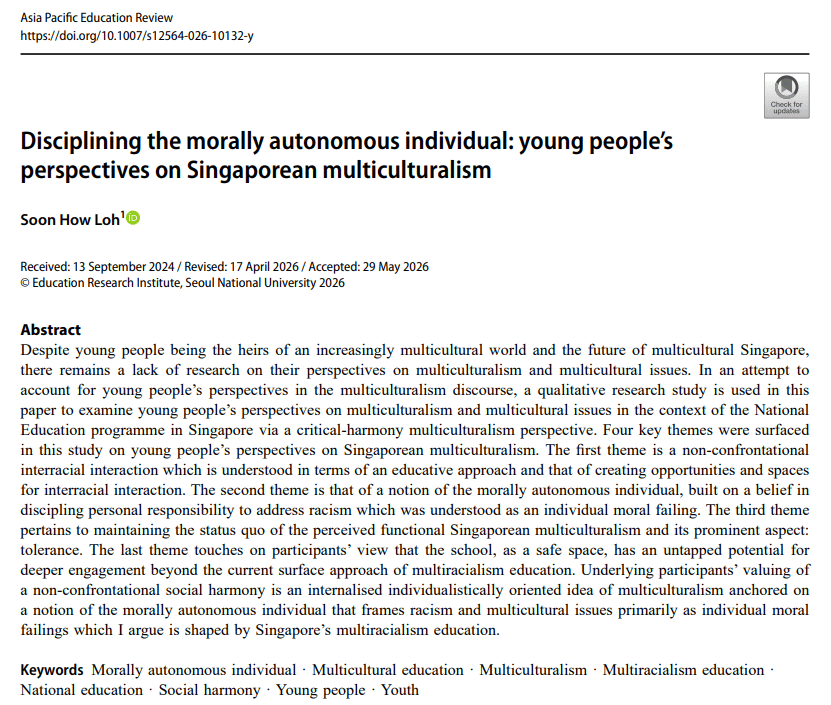
New article: “Disciplining the morally autonomous individual: young people’s perspectives on Singaporean multiculturalism”

This article draws from my master’s thesis research which examines a topic that is deeply important to me – multiculturalism. It is, of course, not an idiosyncratic interest or a niche topic but a prevailing concept that has penetrated mainstream discourse. Nevertheless, it has remained complex and contested (see, for example, my attempt on clarifying the term) and often discussed from a macro perspective without considering young people’s perspectives on multiculturalism. In an arguably highly race-conscious society like Singapore, I find this all the more concerning, especially considering the significance both the government and the public have accorded multiculturalism. There is definitely much to discuss about multiculturalism, to probe at our assumptions about it, constantly revisit what it means in the contemporary multicultural milieu, think about its possibilities and how they can be translated meaningfully, look at how we approach and think about it whether individually or collectively. This is not an exhaustive list. Multiculturalism entails a certain openness, an embrace of the fluidity and dynamism of it, rather than to be constrained by a definitive multiracialism of narrow racialised categories. As I have discussed elsewhere, a restricted ethnoracialised framing of multiculturalism can introduce and condition a multiracialised understanding of national identity, detracting from the principles of multiculturalism as inclusive and fluid. What this article of mine surfaces is that a notion of the morally autonomous individual is deemed desirable and achievable by the participants in my study which reduces racism to an individual moral failing, overlooking structural issues and challenges.

My current paper, published at the Asia Pacific Education Review, examining young Singaporeans’ perspectives on multiculturalism in the context of Singapore is a small contribution to an endeavour in nudging our dialogue on multiculturalism, as part of our efforts to break the spectre of racial conflict and social instability that entrenches a habit of conflict avoidance and disempowered dialogue (this is something I discuss about in another article). An underlying message in my article here is not to discard social harmony, which is a socially desirable public good (and for good reasons), but to see it as compatible with criticality. Participations in my study are cognisant of the importance of social harmony, though seemingly uncritical about Singaporean multiculturalism. However, it is not an indictment of young people’s lack of capacity to critically approach multiculturalism nor is it a simple and straightforward criticism of the education system and programme (despite my critique of Singapore’s multicultural education as “multiracialism education”). Young people can think (here I am invoking Kishore Mahbubani’s question “Can Asians Think?”) but they need to be provided the space, time, and encouragement to do so. Only then can we depart from taking an approach of disciplining the morally autonomous individual in multiculturalism.

The full article can be accessed via the following link: https://rdcu.be/fqoYO

Reference

Loh, S. H. (2026). Disciplining the morally autonomous individual: young people’s perspectives on Singaporean multiculturalism. Asia Pacific Education Review. Advance online publication. https://doi.org/10.1007/s12564-026-10132-y

New encyclopedia entries: “Interculturalism” and “Transcultural identity”

Recently published encyclopedia entries, in the Encyclopedia of Diversity, on two of the topics that I am interested in: interculturalism and transcultural identity. Thank you Mitja Sardoč for the kind invitation to contribute.

References

Loh, S. H. (2025). Interculturalism. In M. Sardoč (Ed.), Encyclopedia of Diversity (pp. 1-8). Springer. https://doi.org/10.1007/978-3-030-95454-3_299-1

Loh, S. H. (2025). Transcultural identity. In M. Sardoč (Ed.), Encyclopedia of Diversity (pp. 1-3). Springer. https://doi.org/10.1007/978-3-030-95454-3_546-1

New article: “A multiracialised national identity: Singaporean multiracialism and national identity”

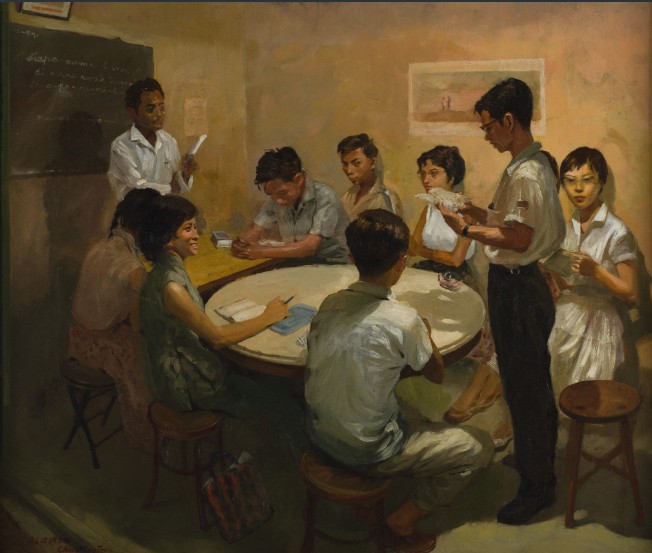
image source: Chua, M. T. (1959). National language class. National Gallery, Singapore. https://www.nationalgallery.sg/sg/en/our-collections/search-collection.artwork.html/national-collection/chua-mia-tee/p/P-0145.jpg.html

Singapore’s national identity has been a topic that many Singaporeans (or at least me) have mulled over for a long time. On the surface, it may seem intuitive and obvious but becomes persistently elusive when one tries to explain what exactly it means to be a Singaporean. With the approaching 60th anniversary of Singapore’s independence, a conversation about the Singapore national identity is gradually becoming more urgent as its continued elusiveness can only feed into our existential anxieties. Engaging the national identity building project in Singapore in my new article published in the Journal of Intercultural Studies, I identify a deep-seated problem that requires attention – specifically that of an emerging ethnoracialised national frame in defining national identity in Singapore; what I have called a multiracialised national identity. This is especially concerning considering the seemingly successful model of multiracialism in Singapore that has long espoused a civic approach in the conceptualisation of national identity. My paper looks into the government-led narrative of national identity and its many challenges in an attempt to unpack the national identity project in the context of Singaporean multiracialism, probing into Singapore’s national identity problematic.

Reference

Loh, S. H. (2025). A multiracialised national identity: Singaporean multiracialism and national identity. Journal of Intercultural Studies. Advance online publication. https://doi.org/10.1080/07256868.2025.2519251

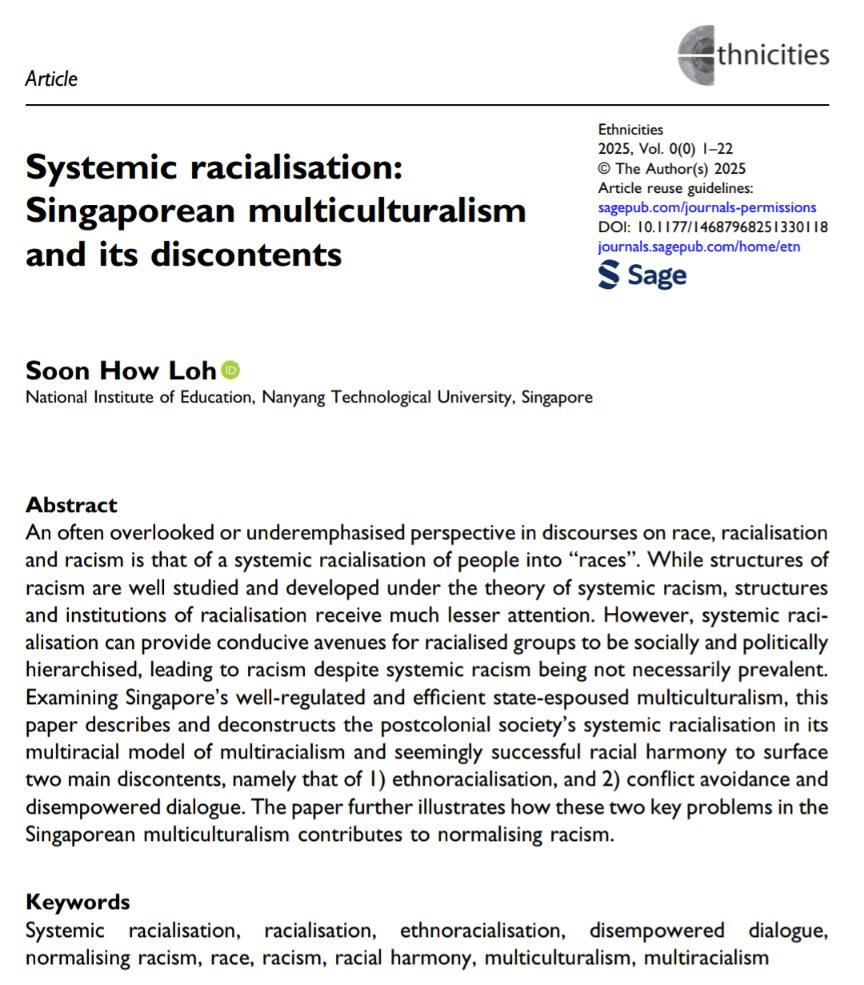
New article: “Systemic racialisation: Singaporean multiculturalism and its discontents”

It is not uncommon for conversations about race to assume a racist framing. This link in itself is not wrong. Racial ideology is persistent and work on racism has matured beyond attitudinal studies, developing into systemic racism to better understand and explain racism and its racial ideology. However, the racialisation of people into “races” seems to remain solely within a racist perspective. That racialisation is simply the process of racialising people, allocating them into a racial hierarchy. This tends to conflate the problem of misidentification of people into descriptive racialised groups in the process of racialisation with the problem of racism as an ideology of racist organisation of society in terms of a social hierarchy. In my paper, I seek to disentangle racialisation from a racist frame, not to suggest that the two concepts of racialisation and racism are completely unrelated and separate but to provide a more nuanced understanding of racialisation so to enrich discourses on race, racialisation, and racism as well as to illustrate their interaction and connection. Singapore as a postcolonial society that embraced multiculturalism since independence provides a useful case for this analysis.

Reference

Loh, S. H. (2025). Systemic racialisation: Singaporean multiculturalism and its discontents. Ethnicities. Advance online publication. https://doi.org/10.1177/14687968251330118

The continued relevance of multiculturalism

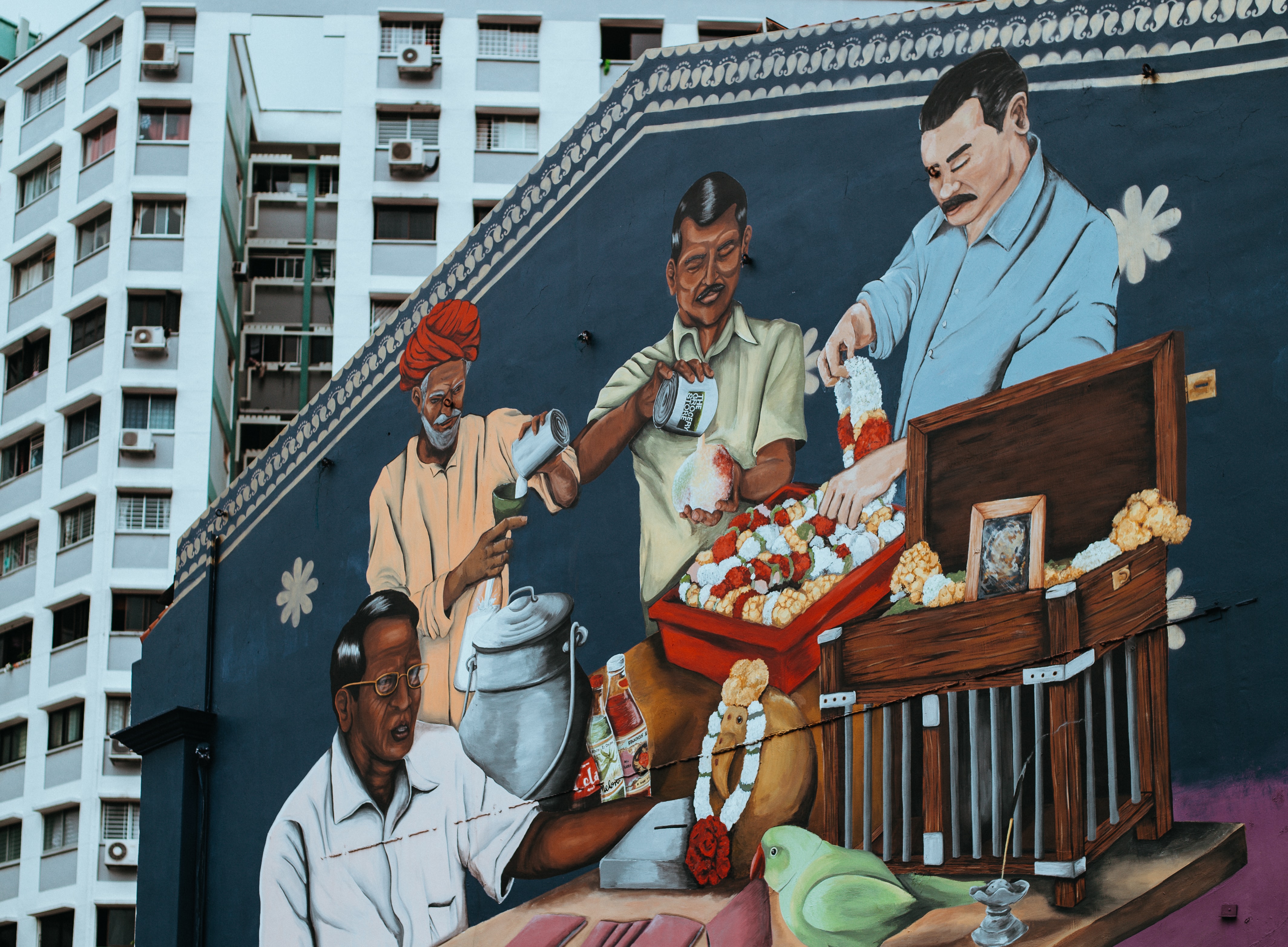
image source: Spratt, A. (2017). Mural of men in Singapore. Unsplash. https://unsplash.com/photos/EoscGO-ACbQ

My first single-author article in Ethnic and Racial Studies is recently published online. My motivation in writing it arises from a need to address why multiculturalism continues to be perceived by some as detrimental to society and the examine the main challenges to its viability in the contemporary society that is experiencing increasing diversification. Two key and related critiques of multiculturalism are cultural essentialism and imposed cultural homogeneity. These have contributed to an idea of a transition away from multiculturalism into a post-multicultural era. In an endeavour to get rid of the conceptual and political baggage of multiculturalism, two alternative approaches to cultural diversity have emerged. These two alternative approaches, interculturalism and transculturalism, have gradually gained prominence and are offered as viable concepts in solving the problems that multiculturalism is alleged to have caused.

In this paper, I seek to provide a conceptual clarification of multiculturalism, rooted in the notion of family resemblance. While the key tenets of interculturalism and transculturalism were critically examined, the thrust of my argument in the paper is not to reject these two alternative concepts. New grand theories and ideas are often constructed in contrast to existing ones. However, in writing this paper, my stance is that in many cases, emerging ideas, while highly critical of existing concepts, can actually serve as catalysts for reforming old ideas either through synthesis or restructuration of their fundamental foci. This competition of ideas can be viewed as transformative potentials and conceptual developments. Although it may not apply to all cases, taking this perspective as an initial default approach in addressing ideas competition could prove beneficial in advancing the field.

My conceptual understanding of multiculturalism points to its potential as a flexible and inclusive approach towards cultural diversity that enables it to continuously engage its detractors and critics. Both interculturalism and transculturalism can help to enrich the multiculturalism discourse and, to borrow from Tariq Modood, serve as multiculturalism’s critical friends.

Reference

Loh, S. H. (2021). The continued relevance of multiculturalism: dissecting interculturalism and transculturalism. Ethnic and Racial Studies. Advance online publication. ​https://doi.org/10.1080/01419870.2021.1963459