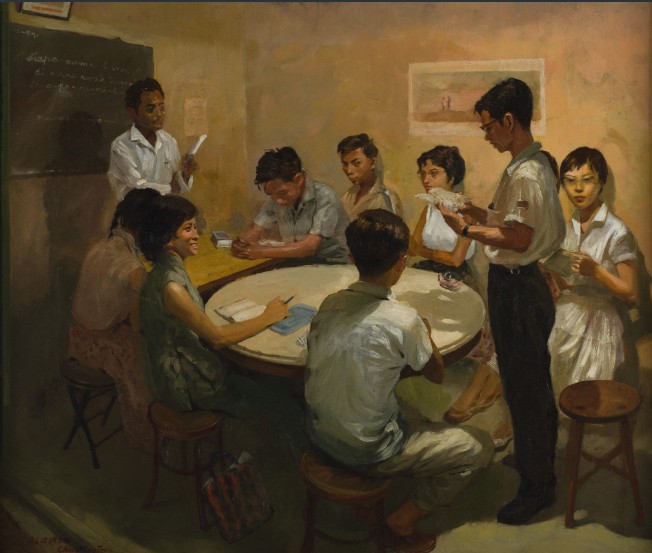
New article: “A multiracialised national identity: Singaporean multiracialism and national identity”

image source: Chua, M. T. (1959). National language class. National Gallery, Singapore. https://www.nationalgallery.sg/sg/en/our-collections/search-collection.artwork.html/national-collection/chua-mia-tee/p/P-0145.jpg.html

Singapore’s national identity has been a topic that many Singaporeans (or at least me) have mulled over for a long time. On the surface, it may seem intuitive and obvious but becomes persistently elusive when one tries to explain what exactly it means to be a Singaporean. With the approaching 60th anniversary of Singapore’s independence, a conversation about the Singapore national identity is gradually becoming more urgent as its continued elusiveness can only feed into our existential anxieties. Engaging the national identity building project in Singapore in my new article published in the Journal of Intercultural Studies, I identify a deep-seated problem that requires attention – specifically that of an emerging ethnoracialised national frame in defining national identity in Singapore; what I have called a multiracialised national identity. This is especially concerning considering the seemingly successful model of multiracialism in Singapore that has long espoused a civic approach in the conceptualisation of national identity. My paper looks into the government-led narrative of national identity and its many challenges in an attempt to unpack the national identity project in the context of Singaporean multiracialism, probing into Singapore’s national identity problematic.

Reference

Loh, S. H. (2025). A multiracialised national identity: Singaporean multiracialism and national identity. Journal of Intercultural Studies. Advance online publication. https://doi.org/10.1080/07256868.2025.2519251
The continued relevance of multiculturalism

image source: Spratt, A. (2017). Mural of men in Singapore. Unsplash. https://unsplash.com/photos/EoscGO-ACbQ

My first single-author article in Ethnic and Racial Studies is recently published online. My motivation in writing it arises from a need to address why multiculturalism continues to be perceived by some as detrimental to society and the examine the main challenges to its viability in the contemporary society that is experiencing increasing diversification. Two key and related critiques of multiculturalism are cultural essentialism and imposed cultural homogeneity. These have contributed to an idea of a transition away from multiculturalism into a post-multicultural era. In an endeavour to get rid of the conceptual and political baggage of multiculturalism, two alternative approaches to cultural diversity have emerged. These two alternative approaches, interculturalism and transculturalism, have gradually gained prominence and are offered as viable concepts in solving the problems that multiculturalism is alleged to have caused.

In this paper, I seek to provide a conceptual clarification of multiculturalism, rooted in the notion of family resemblance. While the key tenets of interculturalism and transculturalism were critically examined, the thrust of my argument in the paper is not to reject these two alternative concepts. New grand theories and ideas are often constructed in contrast to existing ones. However, in writing this paper, my stance is that in many cases, emerging ideas, while highly critical of existing concepts, can actually serve as catalysts for reforming old ideas either through synthesis or restructuration of their fundamental foci. This competition of ideas can be viewed as transformative potentials and conceptual developments. Although it may not apply to all cases, taking this perspective as an initial default approach in addressing ideas competition could prove beneficial in advancing the field.

My conceptual understanding of multiculturalism points to its potential as a flexible and inclusive approach towards cultural diversity that enables it to continuously engage its detractors and critics. Both interculturalism and transculturalism can help to enrich the multiculturalism discourse and, to borrow from Tariq Modood, serve as multiculturalism’s critical friends.

Reference

Loh, S. H. (2021). The continued relevance of multiculturalism: dissecting interculturalism and transculturalism. Ethnic and Racial Studies. Advance online publication. ​https://doi.org/10.1080/01419870.2021.1963459