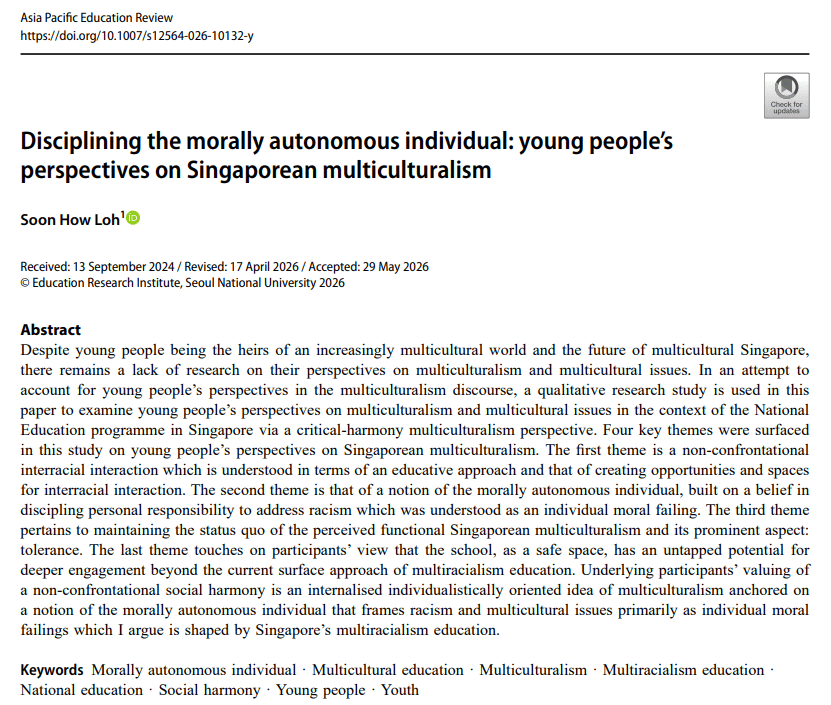
This article draws from my master’s thesis research which examines a topic that is deeply important to me – multiculturalism. It is, of course, not an idiosyncratic interest or a niche topic but a prevailing concept that has penetrated mainstream discourse. Nevertheless, it has remained complex and contested (see, for example, my attempt on clarifying the term) and often discussed from a macro perspective without considering young people’s perspectives on multiculturalism. In an arguably highly race-conscious society like Singapore, I find this all the more concerning, especially considering the significance both the government and the public have accorded multiculturalism. There is definitely much to discuss about multiculturalism, to probe at our assumptions about it, constantly revisit what it means in the contemporary multicultural milieu, think about its possibilities and how they can be translated meaningfully, look at how we approach and think about it whether individually or collectively. This is not an exhaustive list. Multiculturalism entails a certain openness, an embrace of the fluidity and dynamism of it, rather than to be constrained by a definitive multiracialism of narrow racialised categories. As I have discussed elsewhere, a restricted ethnoracialised framing of multiculturalism can introduce and condition a multiracialised understanding of national identity, detracting from the principles of multiculturalism as inclusive and fluid. What this article of mine surfaces is that a notion of the morally autonomous individual is deemed desirable and achievable by the participants in my study which reduces racism to an individual moral failing, overlooking structural issues and challenges.
My current paper, published at the Asia Pacific Education Review, examining young Singaporeans’ perspectives on multiculturalism in the context of Singapore is a small contribution to an endeavour in nudging our dialogue on multiculturalism, as part of our efforts to break the spectre of racial conflict and social instability that entrenches a habit of conflict avoidance and disempowered dialogue (this is something I discuss about in another article). An underlying message in my article here is not to discard social harmony, which is a socially desirable public good (and for good reasons), but to see it as compatible with criticality. Participations in my study are cognisant of the importance of social harmony, though seemingly uncritical about Singaporean multiculturalism. However, it is not an indictment of young people’s lack of capacity to critically approach multiculturalism nor is it a simple and straightforward criticism of the education system and programme (despite my critique of Singapore’s multicultural education as “multiracialism education”). Young people can think (here I am invoking Kishore Mahbubani’s question “Can Asians Think?”) but they need to be provided the space, time, and encouragement to do so. Only then can we depart from taking an approach of disciplining the morally autonomous individual in multiculturalism.
The full article can be accessed via the following link: https://rdcu.be/fqoYO
Reference
Loh, S. H. (2026). Disciplining the morally autonomous individual: young people’s perspectives on Singaporean multiculturalism. Asia Pacific Education Review. Advance online publication. https://doi.org/10.1007/s12564-026-10132-y

