Sitting down on a plastic-cased stool bolted to the tiled floor of a hawker centre evoked a certain feeling of comfort and familiarity despite the seemingly colourful cacophony of sounds and chatter. The interweaving layers of strong aromas sporadically punctuated by whiffs of frying oil accentuated the disorderly element of the hawker centre as one’s senses are consistently assaulted. Yet, such a scene elicited the “heartlander” in me, calling forth positive memories of communal dining in which people have their meals in close spatial proximity but as separate social units. It is the seeming unorchestrated mix of these otherwise isolated social dining units and diverse culinary stalls that contributes to the apparent “disordered” whole which makes up the hawker centre scene.
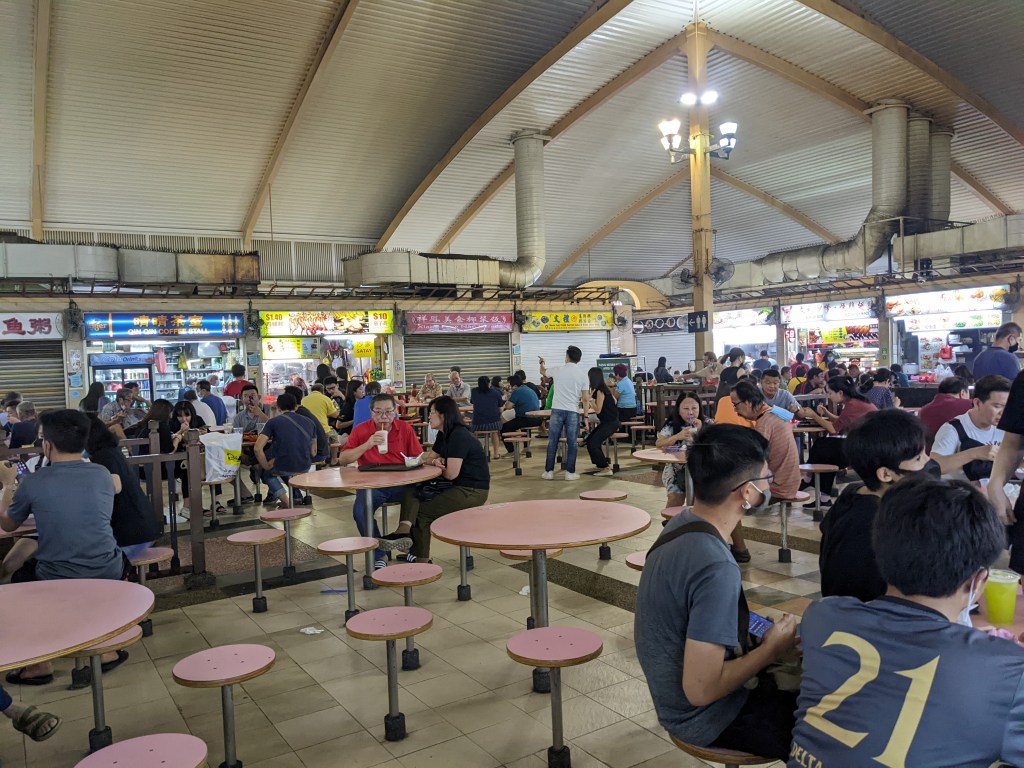
Characterising the hawker centre scene as discombobulating to one’s senses, while a fair experience for persons who are foreign to it, is perhaps missing the intricacies of the hawker centre scene. Underlying all these clashes of the senses on the surface, the hawker centre in fact functions on a set of structured logics. A lot of these logics are in fact cultural and social logics, whether formally implemented, like that of the chairs-around-the-table format for social diners, or informally understood by regular hawker diners in Singapore, like the use of objects (typically a pack of facial tissue papers) to chope (the Singaporean lingo for “reserve”) a table. Most of the sociocultural logics can also be understood as a form of etiquette – the hawker diner etiquette.
The hawker diner etiquette is not a clear-cut set of rules that one can easily refer to understand how to behave when dining at a hawker centre. These rules can change depending on the hawker centre and/or hawker albeit retaining some semblance of a set of common “rules” or social norms. Striping away the most immediate and obvious manifest function of the hawker centre as an dining place to fulfil the biological needs of individuals would also reveal various other functions that are characteristically latent but nonetheless critical contributors to the shaping of the social and cultural norms in the Singaporean society.
One of these latent functions is the hawker centre’s informal role as a common space for people of different cultural and socioeconomic backgrounds. While the more affluent may have a higher tendency to avoid hawker centres, the fact that hawker centres remain relatively accessible, financially and physically, position them as sites with high potential for intercultural interaction. Nevertheless, while I sat at my seat casually nibbling my dinner and people-watching, I could not help but noticed that this opportunity for intercultural interaction remains as that – an opportunity. Nothing more, nothing less. The hawker centre setting is a potentially fertile ground for intercultural interaction to occur and thrive but intercultural interaction mostly occur in mundane terms while its potential to thrive remains a potential. It is not that the mundane intercultural interaction is unimportant. In fact, such everyday intercultural interactions are critical sustenance for the Singaporean multicultural reality. What stood out to me is perhaps our seeming apathy in taking up the opportunity to deepen our intercultural interaction. The general lack of or insufficient multicultural curiosity beyond the mundane. Perhaps it’s a cultural diffidence or a fear of being intrusive. Perhaps we have grown so used to the (perceived) adequacy of the mundane that additional efforts at intercultural interaction is deemed unnecessary. Or perhaps it’s a mixed bag or all of these and more. And there is always the possibility that the hawker centre functions optimally as a site for mundane intercultural interaction and that anything beyond would be straining the limits of its supposed latent functionality.
 Loh Soon How